RESEARCH NOTE / November 8, 2026
Your Reward Shaping Might Disappear at Normalization
In LLM post-training, the reward signal you specify is not the signal that reaches the policy update: GRPO's within-group standardization divides out positive per-prompt reward scales (KAPPO, Matrenok et al., 2026), just as pooled or summed RLHF updates suffer gradient interference even when group rewards remain positively correlated (Cui, Zhang, & Zhou, 2026).
Primary Source (Paper-Reading Note): Controlling Sharpening in LLM Post-Training (KAPPO) · arXiv:2611.03146 (2026)
Simon Matrenok (EPFL), Nicolas Menet (ETH Zürich), Nicolas Flammarion (EPFL), Andreas Krause (ETH Zürich)
Companion Perspective (Section 5): Not All Reward Heterogeneity is Value Conflict: Gradient Interference in Group-Aware RLHF · 2026
Mingxuan Cui (UIUC), Yuji Zhang (CUNY), Duo Zhou (UIUC)
Attribution note: Sections 1–4 of this note are a paper-reading note on Controlling Sharpening in LLM Post-Training by Simon Matrenok, Nicolas Menet, Nicolas Flammarion, and Andreas Krause (arXiv:2611.03146)—that paper is not Duo Zhou’s own work, and all KAPPO derivations, closed-form optimal policies, and calibration analyses belong to its authors. Section 5 connects their normalization finding to our own study on group-aware RLHF by Mingxuan Cui, Yuji Zhang, and Duo Zhou (Code, Project page).
In LLM post-training, the signal you specify at the objective level—whether a per-prompt difficulty scale or a subpopulation’s preference reward—is not the signal that reaches the parameter update. Between the reward function and the policy step sits an optimization operator that normalizes, pools, or combines signals across samples and groups, and that operator can silently rewrite or invert what you asked for.
In Controlling Sharpening in LLM Post-Training, Matrenok, Menet, Flammarion, and Krause (2026) prove that at the level of the KL-regularized objective, optimizing on binary rewards is exact single-reward () optimization with a positive per-prompt reward multiplier that shifts learning pressure toward harder prompts. Yet when that exact reward multiplier is handed directly to Group Relative Policy Optimization (GRPO; Shao et al., 2024), within-group centering and standard-deviation normalization erase it: because is shared across all completions sampled for prompt , it factors out of both the centered numerator and the group standard-deviation denominator and cancels identically (ignoring the denominator stabilizer). To make a per-prompt scale actually change which prompts receive gradient pressure in standardized GRPO, the multiplier must be applied after standardization, outside the normalization quotient. Matrenok et al., 2026, Section 5.2 and Appendix G.
Section 5 pairs this algebraic cancellation with the same structural lesson from the multi-group side of post-training (Cui, Zhang, & Zhou, 2026): in group-aware RLHF, a minority group’s reward can collapse sharply under pooled PPO even when majority and minority rewards remain positively correlated (), and even when both groups’ PPO gradients are included via worst-group objective switching (MaxMin) or unprojected gradient summation (SumGrad), unless conflicting update directions are coordinated directly in gradient space (PCGrad / MGDA).
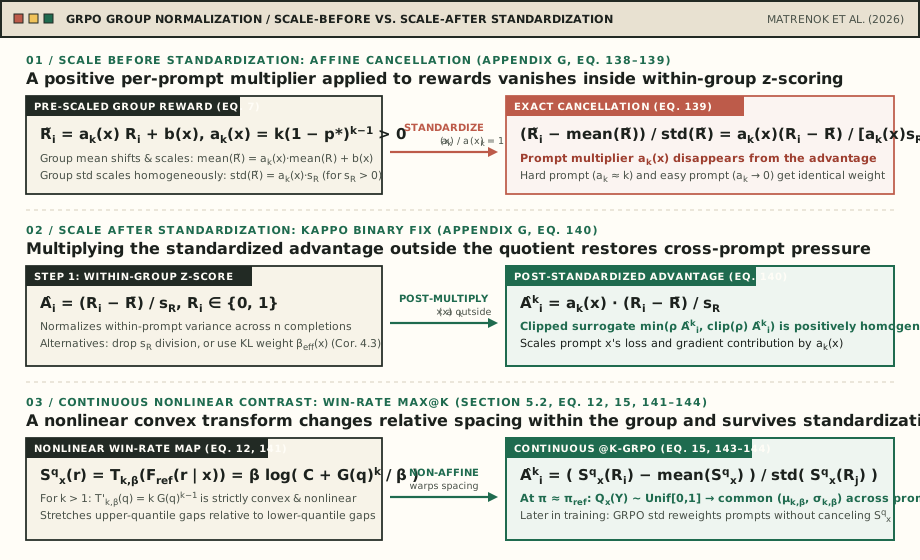
1. What group mean-and-std does to a reward
For a prompt , GRPO samples a group of completions and evaluates their scalar rewards , where . Write the empirical group mean and group standard deviation as
Omitting the numerical denominator stabilizer for a moment and considering any non-degenerate group (; constant-reward groups with receive zero advantages), GRPO defines the baseline-centered, variance-standardized advantage of completion as
Now suppose we replace the raw reward with any prompt-dependent positive affine transformation before group normalization:
Because and depend on the prompt —or on reference-policy statistics of —but not on the index within the group, linearity of the sample mean and positive homogeneity of the standard deviation give
Substituting into the within-group standardized advantage yields immediate cancellation:
Matrenok et al., 2026, Appendix G, Equation (139).
Centering removes ; dividing by the group standard deviation removes . Within-group -scoring is therefore invariant to the entire group of positive per-prompt affine reward transformations.
2. Why a positive per-group scale disappears, and why continuous nonlinear transforms need not
2.1 Binary rewards and the pass-at-k multiplier
To see why this invariance matters, consider how Matrenok et al. (2026) derive @k Adaptive Pressure for Policy Optimization (KAPPO). Standard KL-regularized post-training maximizes
whose closed-form global maximizer is the exponential tilt . Replacing expected single-trial reward with a multi-sample objective —either for binary rewards , or for real-valued rewards—defines the KL-regularized objective
Matrenok et al., 2026, Section 3, Equations (1)–(3).
For binary rewards , is concave in the success probability , and its directional derivative with respect to has score (Appendix B.1, Equations (44)–(49)). Applying their variational optimality lemma (Lemma A.1), Proposition 4.1 proves that the unique optimal policy for is
with partition function , where and . Summing over successful completions yields Proposition 4.2: for every interior reference success rate , is the unique root in of the scalar fixed-point equation
Matrenok et al., 2026, Section 4.1, Propositions 4.1–4.2, Equations (4)–(6), and Appendix B.
Because depends on and only through their ratio, Corollary 4.3 and Corollary 4.4 establish two exact objective-level equivalences with ordinary optimization:
- Prompt-adaptive regularization (Corollary 4.3): Optimize in Equation (1) with raw reward and prompt-dependent KL coefficient .
- Prompt-adaptive reward scaling (Corollary 4.4): Optimize in Equation (1) with constant KL coefficient and rescaled binary reward
Matrenok et al., 2026, Section 4.1, Equation (7), and Appendix G, Equation (138).
Equation (7) explains how counteracts sharpening: easy prompts with high have close to , so and is small (equivalently, is large), curbing probability concentration on already-solved tasks; difficult prompts with small receive a much larger multiplier up to , directing optimization pressure toward rare successes.
However, if a practitioner implements Corollary 4.4 by feeding into standardized GRPO, the multiplier vanishes by Equation (139). More generally, any reward shaping on a binary reward that preserves the ordering between success and failure is an affine map on the two points . Within a group of completions for prompt , there are only two possible reward levels, so standardizing by the group mean and standard deviation maps every non-degenerate binary group with successes to the exact same two advantage values—regardless of how the two binary outcomes were shifted or positively scaled for prompt .
2.2 Why continuous nonlinear transformations survive standardization
The situation changes when rewards take more than two values within a group, such as the fraction of passed test cases in code generation. For real-valued rewards under , Proposition 4.5 and Corollary 4.6 show that the KL-regularized optimal policy is recovered by optimizing the objective with the nonlinear reward transformation
where is the optimal reward CDF. Because reconstructing numerically for every prompt requires solving a coupled forward ODE/recursion over the full reference distribution (Appendix D, Equations (90)–(110)), Matrenok et al. (2026) also derive a closed-form solution (Proposition 4.7) when the reward is expressed as the reference quantile (win rate) :
where the win-rate reward transformation is given explicitly by
Why does feeding directly into GRPO’s within-group standardization (Section 5.2, Equation (15)) work when binary scaling failed? Appendix G (“Continuous reward transformations”, Equations (141)–(144)) and Appendix K.2 (Lemma K.3, Equation (158)) identify two reasons:
- Nonlinear convexity warps relative within-group spacing. Writing in terms of the reference quantile and , differentiating gives
For , is strictly convex and nonlinear on (while -Lipschitz since ). Within-group centering and standardization eliminate only affine changes in reward; because stretches gaps near the upper tail () relative to gaps in the lower tail (), the ratios differ from the untransformed standardized advantages . 2. At initialization, GRPO normalization is common across prompts. Under a continuous reference reward distribution, when for every prompt (Appendix F, Equation (123), and Appendix G, Equation (142)). At the start of training (), the population mean and variance of the transformed reward,
are independent of . Thus, at the population level near initialization, GRPO standardization applies the same affine transformation to every prompt, preserving KAPPO’s cross-prompt difficulty redistribution up to a global constant shift and scale. Matrenok et al., 2026, Appendix G, Equations (141)–(144).
3. KAPPO’s fix: multiply after standardization
Appendix G of Matrenok et al. (2026) diagnoses why the theoretical equivalence in Corollary 4.4 breaks down when plugged naively into standardized GRPO: standardized GRPO does not estimate the policy gradient of the expected-reward objective . Dividing each prompt’s centered rewards by its empirical standard deviation multiplies that prompt’s update by , a policy- and sample-dependent weight that is absent from . That same factor cancels any per-prompt multiplier placed inside the reward.
To retain GRPO’s within-group variance normalization while restoring the cross-prompt pressure redistribution , KAPPO applies the prompt multiplier after standardization:
Matrenok et al., 2026, Appendix G, Equation (140).
Why does multiplying after standardization pass cleanly through the rest of GRPO? Look at the per-token clipped surrogate in the GRPO loss (Section 5.2, Equation (15)):
Because is non-negative and independent of , and for every , the clipped surrogate is positively homogeneous in . Multiplying the standardized advantage by therefore scales prompt ‘s contribution to both the GRPO loss and its gradient by exactly —even when GRPO is trained without an explicit online KL penalty (using only during one-time reference calibration to solve Equation (6) for ).
Matrenok et al. (2026, Appendix G) also note two alternative designs that recover the theoretical interfaces directly without post-hoc rescaling:
| Adaptation Route | Advantage / Loss Modification | Why the Prompt Scale Survives |
|---|---|---|
| Post-standardization scaling (Appendix G, Eq. 140) | in unregularized GRPO | Applied outside ; positive homogeneity of scales the prompt gradient by . |
| Mean-only centering (Appendix G) | Drop division; retain group centering | Centering is linear, so pre-scaled rewards retain directly. |
| Regularization-side adaptation (Corollary 4.3, Eq. 5 & 13) | Keep raw rewards; set per-prompt KL weight in KL-regularized GRPO or @k-DPO | Moves difficulty adaptation out of the normalized reward and into the KL regularizer. |
Single-completion regression (@k-PO, Section 5.2, Eq. 14) | Regress onto using online completion per prompt | No group standardization exists; matches multi-completion PKPO within percentage points on MATH Level 5 (Table 1) with () to () fewer online rollouts. |
4. Caveats: optimization trajectory, zero-success banks, and the epsilon stabilizer
4.1 Same optimum does not mean same training trajectory
Corollaries 4.3, 4.4, and 4.6 are fixed-point equivalences: they guarantee that two KL-regularized objectives share the unique global maximizer (Lemma A.1, Equation (22)). They do not guarantee that two algorithms—or even the same optimizer under reward scaling versus KL rescaling—follow identical parameter trajectories during finite-step gradient descent.
In standardized GRPO, this distinction is even sharper:
- No exact objective-level equivalence under division: Because dividing by alters the expected gradient away from , and because standard RLVR GRPO omits the online KL penalty (Section 5.2), Matrenok et al. (2026, Appendix G) explicitly characterize Equation (140) as an empirical extension that injects their theoretically derived cross-prompt weighting into GRPO’s existing update rule, rather than an exact optimizer of .
- Distribution drift during continuous
@k-GRPO training: For continuous win-rate rewards , the prompt-independence of in Equations (143)–(144) holds at initialization when . As diverges from over training, the win-rate distribution evolves differently across prompts, so becomes prompt-dependent again—layering GRPO’s own variance reweighting on top of KAPPO’s nonlinear reward transformation (Appendix G). - What is tested empirically in the paper: While Appendix G derives the binary post-standardization formula (Equation (140)), the paper’s binary-reward math experiments on MATH and AIME 2026 (
OLMo-3-7B-Instruct-SFTandQwen3-4B-Base, Section 6.2, Figure 2) evaluate@k-PO () and@k-DPO () against standard GRPO, rather than running binary@k-GRPO. The paper’s empirical@k-GRPO experiments (Section 6.3, Figure 4 right) are conducted in the continuous-reward code-generation setting (Qwen3-4B-Basetrained on LeetCodeDataset and evaluated on the hard subset of LiveCodeBench v6 for ).
4.2 Zero successes in a finite calibration bank does not mean zero support
KAPPO estimates prompt difficulty once before training from a static bank of reference completions per prompt (, where ; Appendix J, Equation (145)). Across the MATH training prompts, generating all reference completions takes hours vs. hours for a single 1,000-step training run on 32 NVIDIA GH200 GPUs ( of one run’s wall time, or when amortized over six runs; Equation (147)).
A critical subtlety separates the population boundary from the empirical boundary (Appendices B.3, J.2, and K.1):
- Population zero support (): If the true reference policy assigns zero probability to every valid solution, then no completion in the reference support has . Any policy with finite KL divergence is supported on and therefore also has . The reward term in is identically zero, and the unique KL-regularized optimal policy is with (Appendix B.3, Equation (65)).
- Empirical zero successes ( out of ): In a finite bank of draws, observing does not imply . A hard but solvable prompt with true success rate produces zero successes in independent trials with probability
which for equals 0.740 at and 0.042 at (Appendix K.1). Meanwhile, the exact fixed-point solution of Equation (6) rises steeply near zero: for and , whereas at the very first positive empirical grid point , (Appendix K.1, Figure 5).
- Upward pressure bias on hard prompts: When , the unsmoothed calibration rule sets and assigns the maximum possible reward multiplier (Appendix J.2, Equation (148), and Algorithm 1). On prompts where is small but nonzero, zero-success banks therefore create an upward finite-sample bias in , concentrating maximum pressure on hard prompts (at , has standard deviation and bias at , dropping to and at ; Appendix K.1). At the opposite endpoint (all successes), unsmoothed yields and ; binary
@k-PO sets the regression target to , whereas@k-DPO adds a failure pseudo-count () and caps (Appendix J.2, Equation (149), and Lemma K.2).
4.3 The epsilon stabilizer effect
Equation (139) omits the numerical stabilizer added to the group standard deviation in code. As documented in Appendix J.2 (“Degenerate online groups”), the implementation divides centered rewards by the group standard deviation plus . What happens if a positive multiplier is applied before standardization when is present?
For a group with raw empirical standard deviation , pre-scaling yields
Two regimes follow immediately:
- Degenerate groups (): When all completions achieve the same reward (), the numerator vanishes identically, so (and post-standardization scaling also gives ).
- Non-degenerate groups (): Dividing numerator and denominator by gives
Instead of multiplying the advantage by , pre-standardization scaling only rescales the stabilizer from to . On any mixed binary group of size (the GRPO group size in Appendix H), at least one completion succeeds and at least one fails, so (under variance, or under sample variance)—more than five orders of magnitude larger than . For hard and moderate prompts where , the relative discrepancy between and the unscaled advantage is on the order of to . The stabilizer only makes pre-scaling noticeable in the extreme limit (when on a nearly deterministic easy prompt), where grows large and damps the advantage toward zero—still failing to provide the intended proportional scaling across interior prompts.
5. The same lesson from the other side: gradient interference in group-aware RLHF
KAPPO’s GRPO analysis exposes a general phenomenon in LLM post-training: specifying the right reward or objective does not guarantee that the policy update moves in that direction. In Matrenok et al. (2026), the obstacle between the reward specification and the parameter update is GRPO’s within-group standardization operator, which divides out before the gradient is formed. In our own work—Not All Reward Heterogeneity is Value Conflict: Gradient Interference in Group-Aware RLHF by Mingxuan Cui, Yuji Zhang, and Duo Zhou (Code, Project page)—the exact same gap between reward-space intent and update-space reality appears across heterogeneous preference groups.
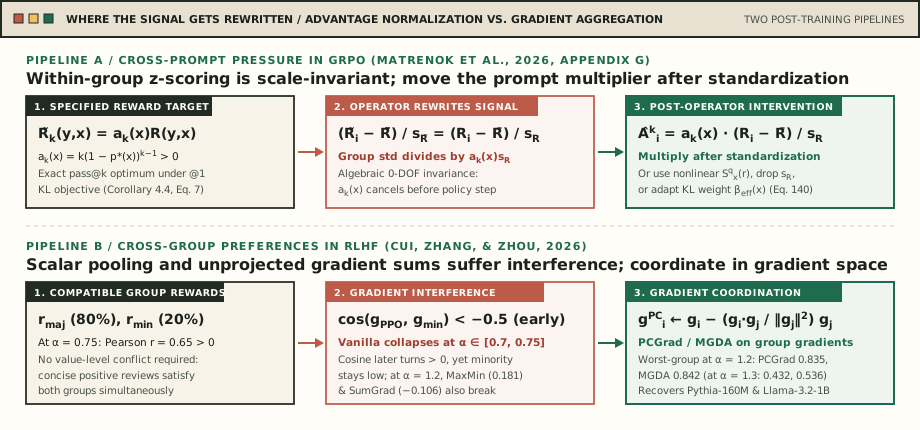
5.1 Value-level conflict versus optimization-level interference
When standard single-reward RLHF (Equation (1) in Cui, Zhang, & Zhou, 2026) trains a single reward model on pooled comparisons from a heterogeneous population and optimizes a policy with PPO, minority preferences are often left poorly served. A natural assumption is that this disparity reflects an unavoidable value-level conflict—that improving one group’s reward necessarily lowers another’s. Cui, Zhang, & Zhou (2026, Section 1 and Section 2.1) separate that hypothesis from optimization-level interference, where the policy update computed by the optimizer points against a group’s reward-improving gradient direction even when a mutually beneficial policy exists.
To test these two mechanisms cleanly, Cui, Zhang, & Zhou (2026, Section 2.2 and Appendix B) construct a controlled benchmark on IMDb movie reviews (Maas et al., 2011) with an majority group and a minority group over two response attributes: a positive sentiment score (from lvwerra/distilbert-imdb) and a normalized conciseness score with . A single divergence parameter interpolates between complete agreement and direct opposition:
At , the two group rewards are identical (); at , they reduce to the two orthogonal raw attributes (); and only for does improving one attribute directly penalize the other (; Figure 2 of Cui, Zhang, & Zhou, 2026). All runs use length-normalized mean per-token KL () so length-sensitive regularization cannot confound conciseness (Section 2.2 and Appendix B.1).
The central empirical finding in Section 3.1 (Figures 1 and 3) is that single-reward (vanilla) RLHF suffers a sharp minority-reward collapse as moves from to , while the majority reward stays high—even though the two groups’ oracle rewards are still strongly positively correlated at the collapse point (). Short, positive reviews satisfy both groups simultaneously (at on prompt "This movie had", MaxMin, SumGrad, and PCGrad all generate -token positive reviews achieving minority reward and majority reward , whereas vanilla RLHF produces a -token repetitive review with minority reward and majority reward ; Appendix D.4, Table 3). The collapse at is therefore not a value-level trade-off; it is an optimization artifact of how pooled RLHF translates compatible rewards into parameter updates.
5.2 Temporal dynamics: when disappearance of negative cosine does not mean recovery
Tracking the cosine similarity between the vanilla PPO policy update and the minority group’s reward gradient across training steps reveals how the minority signal is lost (Cui, Zhang, & Zhou, 2026, Section 3.1, Figure 4, and Appendix D.1, Figure 6):
- Strong early anti-alignment: At and , drops below during the early stages of PPO training (around steps ). Removing the KL term from the vanilla gradient leaves this early negative dip unchanged (Appendix D.1, Figure 6), confirming that interference comes from the reward gradients rather than the KL penalty.
- Vanishing negative alignment without behavioral recovery: Later in training, climbs back above zero and becomes positive—yet minority reward remains collapsed at convergence. Why? Early anti-aligned updates push the policy into generating uniformly long responses with little length variance. Once on-policy rollouts lack concise candidates, the variance of within a batch vanishes, so the remaining sentiment component dominates the minority gradient on the collapsed support. Local gradient agreement returns only after the policy has already abandoned the region of response space where the minority group is well served.
5.3 Structural mapping: moving the intervention to where the operator acts
Comparing how KAPPO (Matrenok et al., 2026) repairs GRPO and how Cui, Zhang, & Zhou (2026) repair group-aware RLHF highlights a shared design principle: when an intermediate step in the optimizer erases or distorts a reward-level signal, the intervention must be placed at or after that operator:
- In KAPPO on GRPO (Matrenok et al., 2026, Appendix G): Rescaling binary rewards before within-group standardization fails because standardization projects every non-degenerate binary reward vector onto a fixed norm (). Moving the multiplier after standardization, (Equation (140)), bypasses the scale-invariant quotient so positive homogeneity of the clipped surrogate carries into the parameter update.
- In Group-Aware RLHF (Cui, Zhang, & Zhou, 2026, Section 2.1 and Section 3.2): Merely preserving separate group rewards at the objective level is not enough once enters the conflicting regime (). Specifically, Cui, Zhang, & Zhou (2026) compare four group-aware rules on the exact same rollout batches and group reward models (Appendix C.1–C.4):
- Worst-group objective selection (
MaxMin-RLHF, Equation (2)): Selects on each batch and runs PPO on . This fixes the compatible-regime collapse (), but because each step applies a single group’s unprojected gradient, alternating updates work against each other at (Figure 5) and worst-group reward drops to at and at (Table 1). - Unprojected gradient addition (
SumGrad): Forms separate group PPO gradients and applies . Including both groups’ gradients without modifying their directions holds through (), but collapses to at and at (Table 1). - Explicit gradient coordination (
PCGrad-PPO, Equation (3), andMGDA-PPO): When ,PCGradprojects each group gradient onto the normal plane of the other before summing:
- Worst-group objective selection (
while MGDA forms the minimum-norm convex combination (Appendix C.4). Both methods prevent destructive interference at the gradient-aggregation step and sustain high worst-group reward deep into the conflicting regime:
| Divergence Parameter | Regime (Group Reward Correlation) | MaxMin Worst-Group | SumGrad Worst-Group | PCGrad Worst-Group | MGDA Worst-Group |
|---|---|---|---|---|---|
| Positively correlated () | |||||
| Positively correlated (, vanilla collapses) | |||||
| Orthogonal () | |||||
| Mildly conflicting () | |||||
| Strongly conflicting () | |||||
| Strongly conflicting () |
The same collapse-and-recovery pattern holds across model backbones at (Cui, Zhang, & Zhou, 2026, Section 3.2 and Appendix D.3, Table 2): on Pythia-160M, minority reward rises from (Vanilla) to (MaxMin) and (PCGrad, with majority vs. vanilla ); on Llama-3.2-1B, minority reward rises from (Vanilla) to (MaxMin) and (PCGrad, with majority vs. vanilla ).
5.4 Where the analogy breaks
Being precise about where these two mechanisms differ is just as important as noting their parallel:
- Exact algebraic invariance versus empirical gradient dynamics: KAPPO’s cancellation in Equation (139) is an exact, zero-degree-of-freedom algebraic identity on every single prompt group: for any and , holds deterministically at every step, for every parameter vector , before any gradient is even computed. By contrast, minority collapse in Cui, Zhang, & Zhou (2026) is a high-dimensional, trajectory-dependent optimization phenomenon in parameter space : pooled Bradley–Terry reward fitting ( split) and on-policy PPO updates create early negative inner products that drive the policy out of concise-text support.
- Scalar rescaling across prompts versus directional projection on the same parameters: In KAPPO’s binary GRPO fix (Equation (140)), each prompt has a single scalar difficulty multiplier ; multiplying after standardization simply reweights how strongly prompt ‘s gradient contributes to the batch sum. In group-aware RLHF, the two groups apply competing vector fields to the same policy parameters simultaneously. As
SumGradandMaxMinat demonstrate, scalar reweighting of group losses or alternating which group gets the step cannot eliminate a negative inner product when preferences conflict;PCGradandMGDAwork because they alter the direction of the update in . - Closed-form global optimum versus multi-objective Pareto geometry: Matrenok et al. (2026) study a single scalar objective whose unique global maximizer can be written in closed form (Propositions 4.1, 4.5, and 4.7) and matched on in-distribution and shifted benchmarks (
MATH,AIME 2026,LeetCodeDataset,LiveCodeBench v6withOLMo-3-7B-Instruct-SFTandQwen3-4B-Base). Cui, Zhang, & Zhou (2026) study a multi-group setting on a controlled two-attributeIMDbbenchmark (GPT-2,Pythia-160M,Llama-3.2-1B) where no single scalar objective defines the optimum across all , and where gradient-alignment diagnostics were measured onGPT-2(with backbone transfer verified via reward outcomes onPythia-160MandLlama-3.2-1Bin Appendix D.3).
6. Takeaways: a practical check for practitioners
Whenever you design a post-training intervention—whether difficulty-aware reward shaping for reasoning (KAPPO; Matrenok et al., 2026) or pluralistic preference aggregation (PCGrad-PPO / MGDA-PPO; Cui, Zhang, & Zhou, 2026)—audit the operator that sits between your reward specification and the parameter update:
- Check whether your reward shaping is within-group affine. For a fixed prompt across completions , if with —including any order-preserving transform of a binary reward , such as KAPPO’s —then within-group centering removes and dividing by the group standard deviation cancels (up to ).
- Place scalar prompt weights after within-group standardization (or out of the standardized reward). In GRPO, multiply outside the normalized advantage, (Matrenok et al., 2026, Equation (140)), so positive homogeneity of the clipped surrogate scales the prompt’s gradient by . Equivalently, drop division and keep mean-only centering, move the scale into the KL weight (Corollary 4.3), or use single-completion
@k-PO—which matches multi-completion PKPO within percentage points on MATH Level 5 while cutting online rollouts by () to (; Table 1 and Appendix L). - For multi-level continuous rewards, use nonlinear transformations that warp within-group spacing. When rewards take multiple values in , a strictly convex nonlinear map like KAPPO’s win-rate transform stretches upper-quantile gaps relative to lower-quantile gaps and survives within-group standardization (Matrenok et al., 2026, Section 5.2, Equation (15), and Appendix G, Equations (141)–(144)).
- Do not confuse reward compatibility—or late-stage gradient cosine—with interference-free optimization. As Cui, Zhang, & Zhou (2026) show, a minority preference can collapse under pooled PPO while group rewards are still positively correlated (), driven by early negative gradient alignment () that later fades to positive only because the policy has lost support on concise completions. When combining heterogeneous objectives, intervene where the vectors collide—via gradient coordination (
PCGradorMGDA) rather than pooled scalars or unprojected gradient sums.
Cite this note
@misc{zhou2026rewardscalingnormalization,
  author = {Zhou, Duo},
  title  = {{Your Reward Shaping Might Disappear at Normalization}},
  year   = {2026},
  url    = {https://www.duo-zhou.com/blog/reward-scaling-normalization/},
  note   = {Research note}
}