PROJECT FILE / Manuscript
Gradient Interference in RLHF
Minority collapse in single-reward RLHF can appear while the group rewards still agree.
Not All Reward Heterogeneity is Value Conflict: Gradient Interference in Group-Aware RLHF
Mingxuan Cui, Yuji Zhang, Duo Zhou
arXiv coming soon · Code coming soon
Two ways a minority group can be left behind
Standard RLHF fits one reward to pooled comparisons, then optimizes a policy against that reward. When preferences differ, the pooled reward can serve one group well and leave another poorly aligned. The question is which mechanism produces that disparity.
This paper separates two of them:
| Failure | What has gone wrong |
|---|---|
| Value-level conflict | Raising one group’s reward requires lowering the other’s. |
| Optimization-level interference | The policy update points against a group’s reward-improving direction. |
The two can come apart. Group rewards can still move together while the update computed from the pooled objective works against the smaller group.
Turn agreement into conflict with one parameter
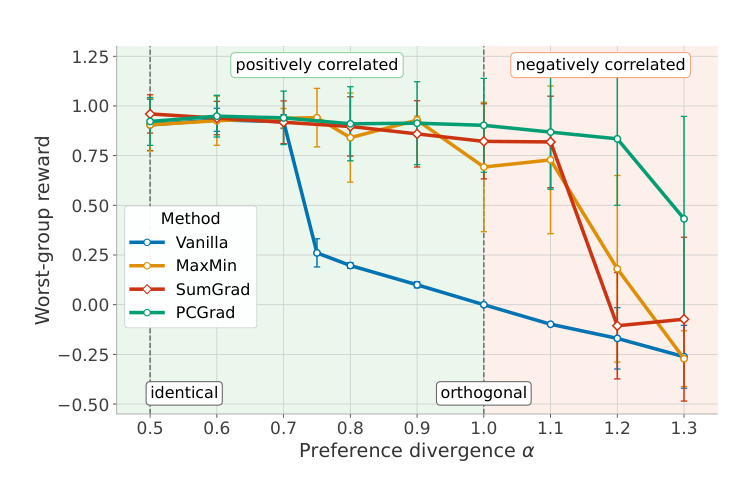
The benchmark is a controlled IMDb review task with a fixed 80/20 population split. The majority reward emphasizes positive sentiment. The minority reward emphasizes conciseness. A mixing weight sets how far apart those rewards are. At the two rewards are the same. At each reward is one raw attribute. For improving one attribute explicitly penalizes the other.
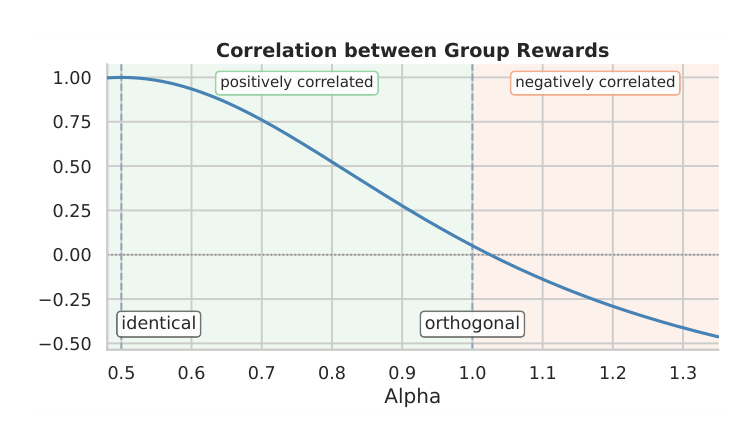
Single-reward RLHF keeps a high majority reward across this sweep. The minority reward drops sharply as moves from to . At that collapse the group rewards are still positively correlated across the completion pool, with Pearson , because short, positive reviews satisfy both groups. The failure is that global reward correlation on a static pool does not imply local gradient alignment around the current policy. Under an 80/20 split, the steepest direction for the pooled reward is to pad generations with extra positive phrasing, which lengthens the output and points directly against the minority conciseness gradient. The sampled text becomes long, repetitive, and strongly positive as the pooled objective locks onto the majority attribute.

Group-aware methods, trained under the same preference settings, avoid that collapse and keep a comparable majority reward. The disparity is in how the aggregated reward becomes an update.
The harmful step happens early
Near the collapse, cosine similarity between the KL-regularized PPO update and the minority reward gradient falls below early in training, at and .
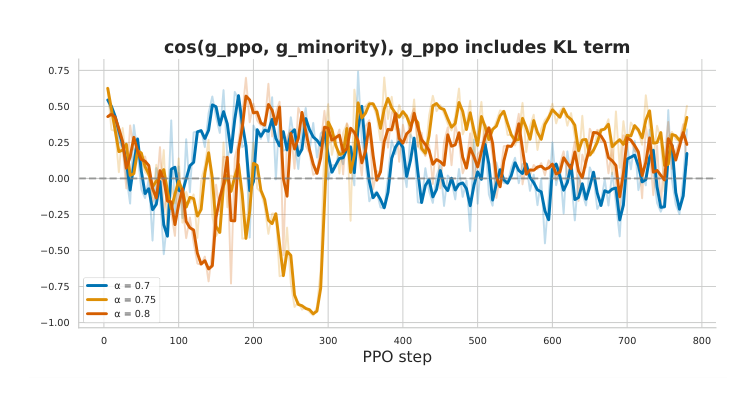
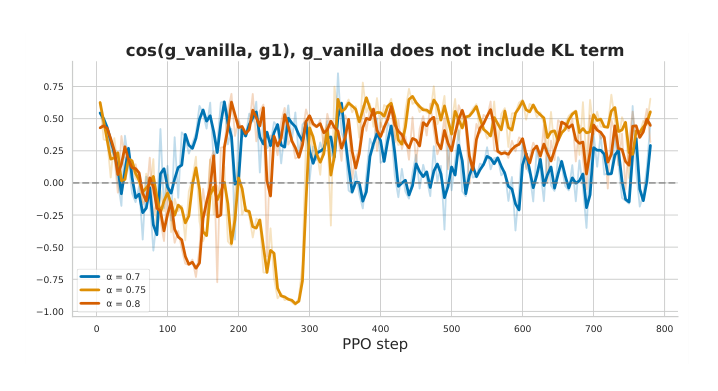
The same early anti-alignment remains when the KL term is left out of the cosine, so the regularizer does not account for the whole effect. Later in training the similarity turns positive again, yet the minority reward stays low. Once early conflicting steps push the generator into long, repetitive completions, on-policy rollout loses support on concise text; local gradients that stop opposing conciseness inside that collapsed region cannot recover a mode the policy no longer samples.
Using every group is different from coordinating their gradients
The comparisons hold the preference data fixed and change only the update rule:
| Method | Update rule | What changes |
|---|---|---|
| Vanilla RLHF | One reward fit to the pooled data | The single-reward baseline. |
| MaxMin-RLHF | Optimize the current worst group | Which objective is active. The active group switches as relative scores cross. |
| SumGrad | Add the two group PPO gradients | Both learning signals are kept, and their directions are left unchanged. |
| PCGrad-PPO | Remove conflicting components, then combine those same gradients | The part of each update that opposes the other group is taken out. |
| MGDA-PPO | Minimum-norm convex combination of the group gradients | A second coordination rule, so the result is not tied to one projection formula. |
MaxMin-RLHF raises worst-group reward once vanilla RLHF begins to fail, including while the rewards are still positively correlated. It does that by training against whichever group is currently behind. SumGrad holds through moderate divergence. Once the preferences conflict more strongly, adding the gradients is not enough.
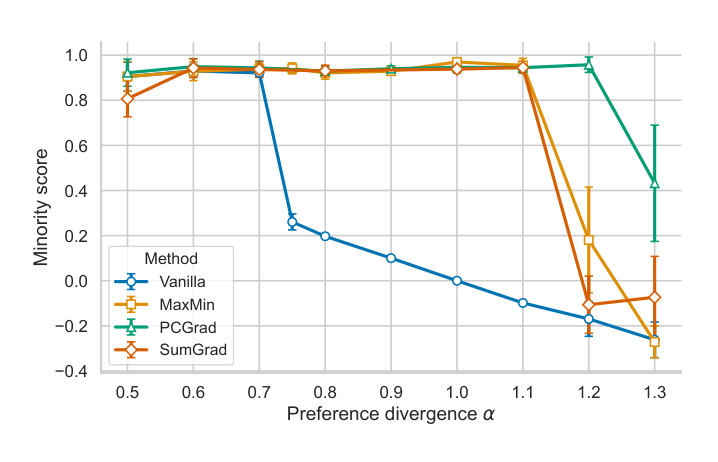
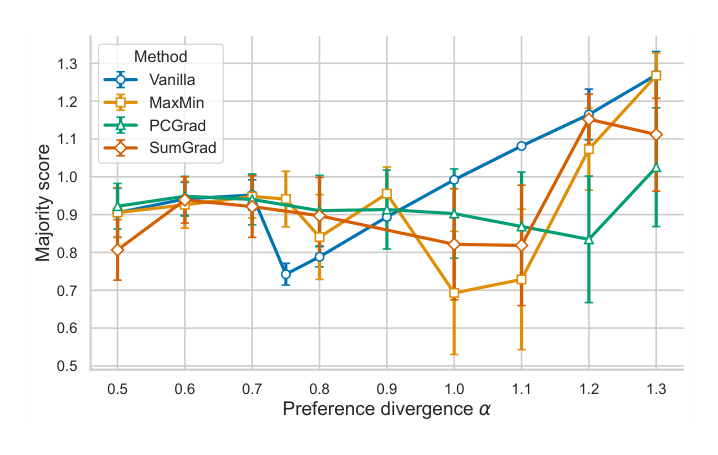
Worst-group reward on the sweep:
| MaxMin | SumGrad | PCGrad | MGDA | |
|---|---|---|---|---|
| 0.6 | 0.926 | 0.939 | 0.949 | 0.937 |
| 0.8 | 0.841 | 0.897 | 0.910 | 0.924 |
| 1.0 | 0.693 | 0.822 | 0.903 | 0.912 |
| 1.1 | 0.729 | 0.819 | 0.869 | 0.825 |
| 1.2 | 0.181 | −0.106 | 0.835 | 0.842 |
| 1.3 | −0.272 | −0.073 | 0.432 | 0.536 |
At , SumGrad’s worst-group reward is . PCGrad-PPO reaches and MGDA-PPO reaches from the same group gradients. MGDA is a second way of combining those gradients, a minimum-norm convex combination, so the recovery is not tied to PCGrad’s projection. The line plots above do not include MGDA.
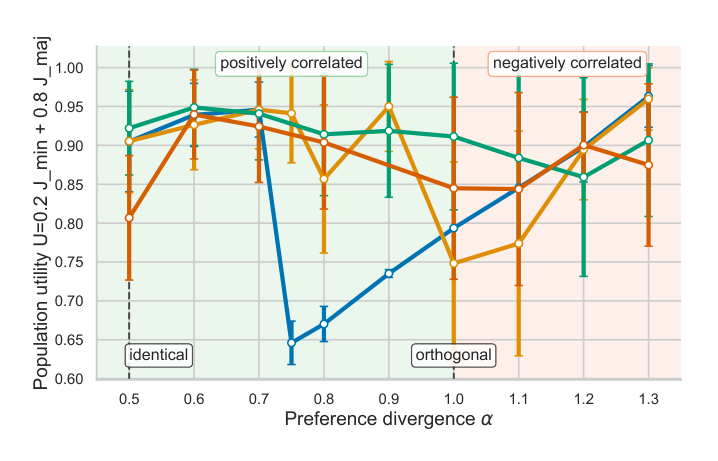
That minority collapse is easy to miss on an aggregate dashboard. Weighted by the 80/20 population split, overall utility dips briefly between and and then climbs back up as the policy over-optimizes the majority sentiment reward, masking the minority collapse behind a rising population mean.
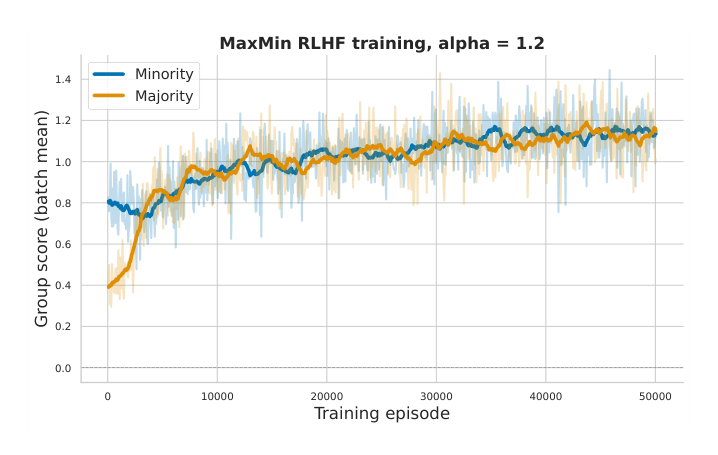
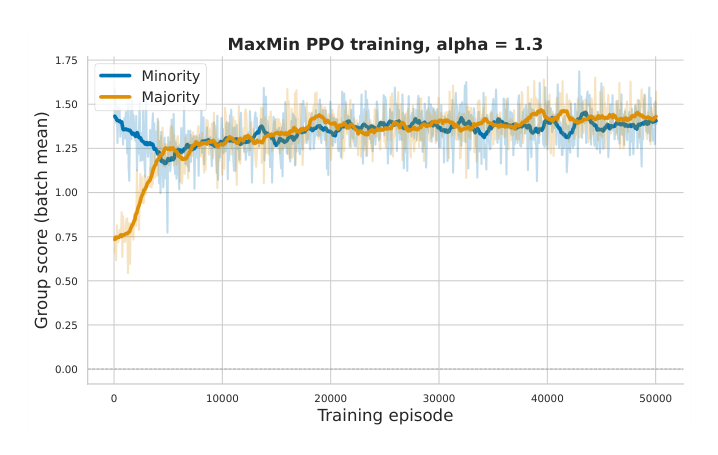
The training trajectories of MaxMin-RLHF at and show why scalar objective switching still breaks down under strong divergence. By always training on whichever group is currently behind, MaxMin successfully pulls the lagging group toward the leading group so that the two batch scores track each other. However, because each step still applies a single group’s unprojected gradient, strongly opposing updates undo each other’s progress and lock both groups at a low plateau ( at and at ), whereas projecting out the conflicting gradient component in PCGrad or MGDA keeps worst-group reward above at .
The collapse and the recovery both recur when the backbone changes. At , with the same architecture used for the policy and the reward model, vanilla minority reward is on Pythia-160M and on Llama-3.2-1B. PCGrad-PPO reaches and , while majority reward stays near the vanilla level.
| Backbone | Method | Minority | Majority |
|---|---|---|---|
| Pythia-160M | Vanilla | 0.076 | 0.653 |
| Pythia-160M | MaxMin | 0.957 | 0.619 |
| Pythia-160M | PCGrad | 0.968 | 0.654 |
| Llama-3.2-1B | Vanilla | 0.027 | 0.684 |
| Llama-3.2-1B | MaxMin | 0.902 | 0.695 |
| Llama-3.2-1B | PCGrad | 0.956 | 0.705 |
On one evaluation prompt at , vanilla RLHF writes a 301-token repetitive review, with minority reward and majority reward . PCGrad-PPO answers the same prompt in 15 tokens, with minority reward and majority reward . That pair is one illustration from the paper. The plots and tables above are the aggregate comparison.
Scope
The groups are synthetic attributes on IMDb reviews, sentiment against conciseness, at an 80/20 split. They are task attributes. The main experiments use GPT-2 and two groups. The result is a diagnostic of one optimization failure in aggregated RLHF: a minority group can be left behind by the update rule while the group rewards are still compatible. Larger models, preference data collected from people, and settings with more than two groups remain open. Together with Cumulative Fisher Protection and Geometric Unlearning, this work treats post-training tradeoffs as directional conflicts in parameter space rather than scalar weights in the loss.
Cite the paper
@misc{cui2026gradientinterference,
  author    = {Cui, Mingxuan and Zhang, Yuji and Zhou, Duo},
  title     = {Not All Reward Heterogeneity is Value Conflict: Gradient Interference in Group-Aware {RLHF}},
  year      = {2026},
  url       = {https://www.duo-zhou.com/projects/gradient-interference-rlhf/}
}