PROJECT FILE / Under review
Cumulative Fisher Protection
Alignment can move a long way if it stays off the directions a capability is sensitive to.
Where the Policy Moves Matters: Capability Preservation via Cumulative Fisher Protection in RLHF
Under review. arXiv coming soon · Code coming soon
The penalty should have the shape of the capability
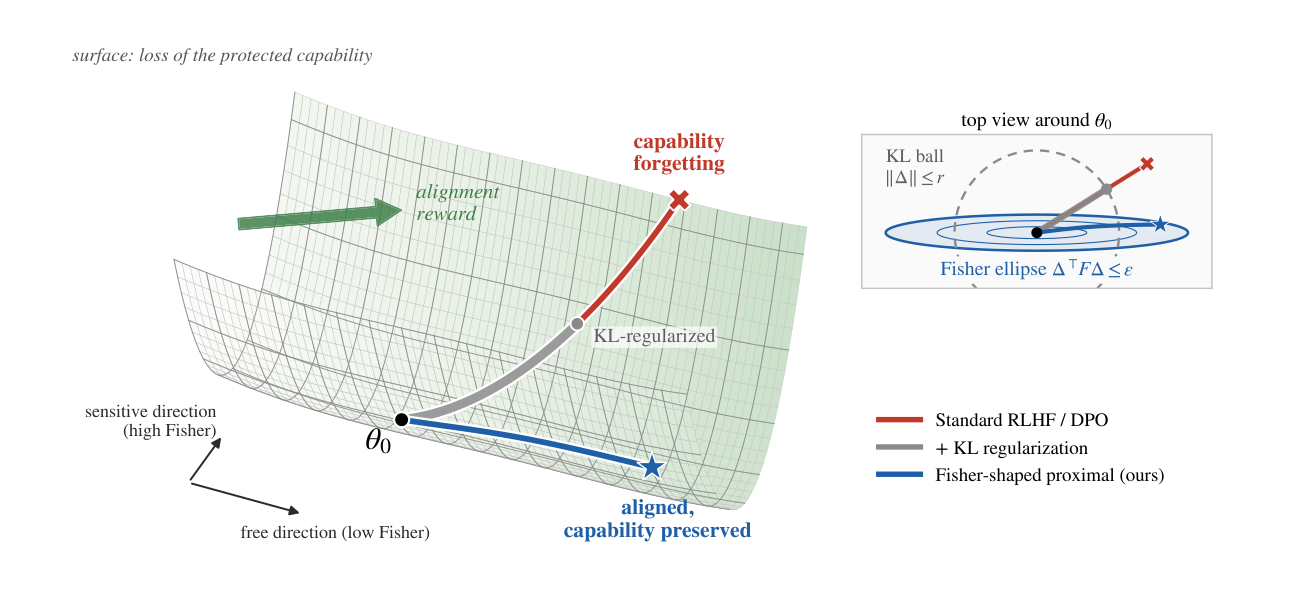
A KL penalty pulls the policy toward the reference on the prompts used for alignment. A capability lives on a different set of prompts, and it is sensitive to a different set of parameter directions. Shortening every step by the same amount, which is what a larger KL coefficient does, still lets the path wander along the directions that change math, code, or refusal behavior. InstructGPT already saw the practical version of this: raising the KL coefficient by two orders of magnitude left regressions on DROP and SQuAD in place and cut the reward.
Cumulative Fisher Protection (CFP) builds the penalty from the capability. At the initial policy, sample prompts from the capability and responses from the model, and form the output Fisher, the second moment of . Directions with large Fisher eigenvalues are the ones in which a small parameter step changes the output distribution. The correction is then a proximal map on the whole path from initialization, not a penalty on the latest step. In the diagonal form used in the experiments, coordinate with Fisher weight moves by
A sensitive coordinate is pulled back toward , while a coordinate the capability barely uses keeps the optimizer’s proposal . Writing , the update is : under a persistent alignment bias , preconditioning only the step still lets displacement grow linearly with , whereas shrinking the cumulative path acts as a restoring force with a bounded fixed point . The base optimizer can be PPO or DPO. The Fisher is estimated once, from 128 calibration sequences, and then held fixed.
What has to be measured is the path, not the step
Successive updates can reinforce or cancel. A single gradient that looks safe can still land, after a hundred steps, deep in a sensitive direction. The diagnostic is therefore the displacement from the initial checkpoint. Sensitive drift is the Fisher-weighted length . Free drift is the ordinary length of on the 99% of coordinates with the smallest Fisher weights. The intended picture is a curve that keeps moving right and stops climbing.
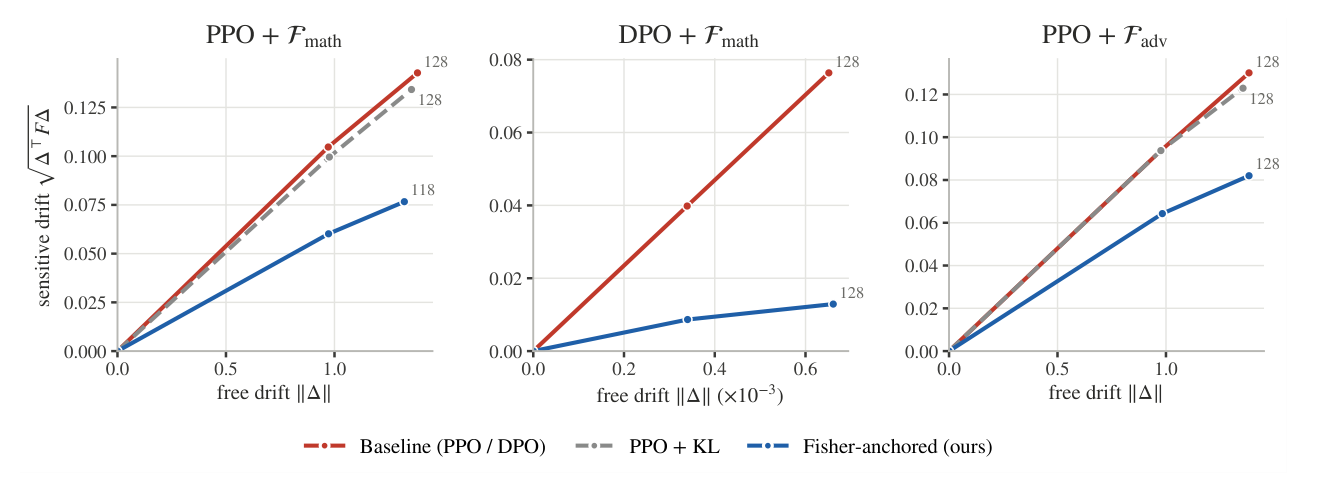
At step 64 the quadratic version of that drift, relative to the unregularized run of the same optimizer, splits the methods cleanly. Each anchor suppresses its own domain the most. It also suppresses the others: a math anchor, built with no code prompts, still cuts code-sensitive drift by 40%, showing that structured reasoning skills share a large fraction of their high-curvature parameter directions.
| Training arm | Math Fisher | Safety Fisher | Code Fisher |
|---|---|---|---|
| PPO + KL | −10% | +1% | −7% |
| PPO + math anchor | −67% | −32% | −40% |
| PPO + safety anchor | −46% | −53% | −34% |
| PPO + code anchor | −33% | −14% | −41% |
| DPO + math anchor | −95% | −93% | −63% |
KL is the control that shows why the shape matters. It changes the math drift by 10% and the safety drift by about zero. The anchor changes the math drift by 67%, with for PPO and for DPO.
The scoreboard moves by a point. The path moves by a lot.
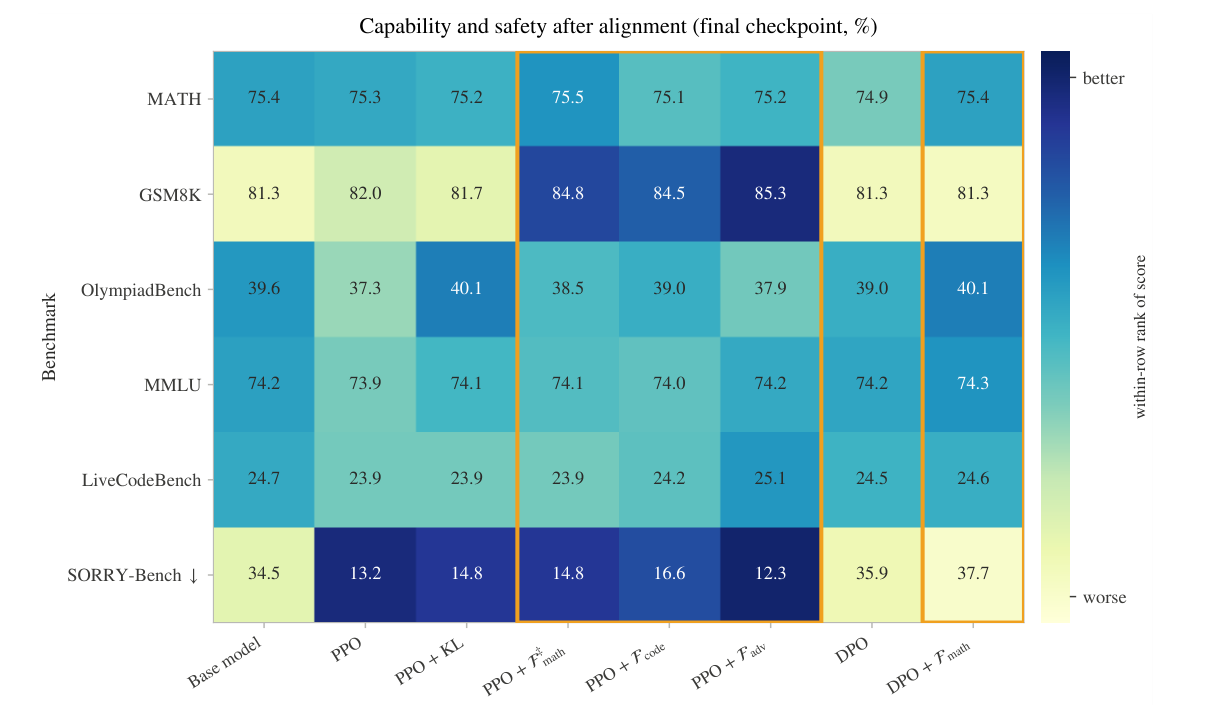
Pass-rate benchmarks are thresholded step functions of the model’s log-probabilities; Fisher-weighted drift measures the continuous parameter motion that precedes a score drop. On Qwen2.5-7B-Instruct, unregularized PPO takes OlympiadBench from the initial 39.56% to 37.33%. The three anchors land between 37.93% and 38.96%; the math anchor reaches 38.5%, moves MATH from 75.30% to 75.48%, and lifts GSM8K from 82.0% under PPO (81.3% initially) to 84.5–85.3% across the anchored runs. On OlympiadBench that is a partial recovery, and it should be read as one: PPO with a KL penalty reaches 40.1% on that single column while barely bending the sensitive path (−10% math drift against −67% for the anchor). A single benchmark cell can rise from variance or length shifts without staying off the capability’s sensitive directions.
Under DPO the geometry and the score move together. Math anchoring brings MATH from 74.88% back to the initial 75.36%, and OlympiadBench from 38.96% to 40.15%, above the initial 39.56%.
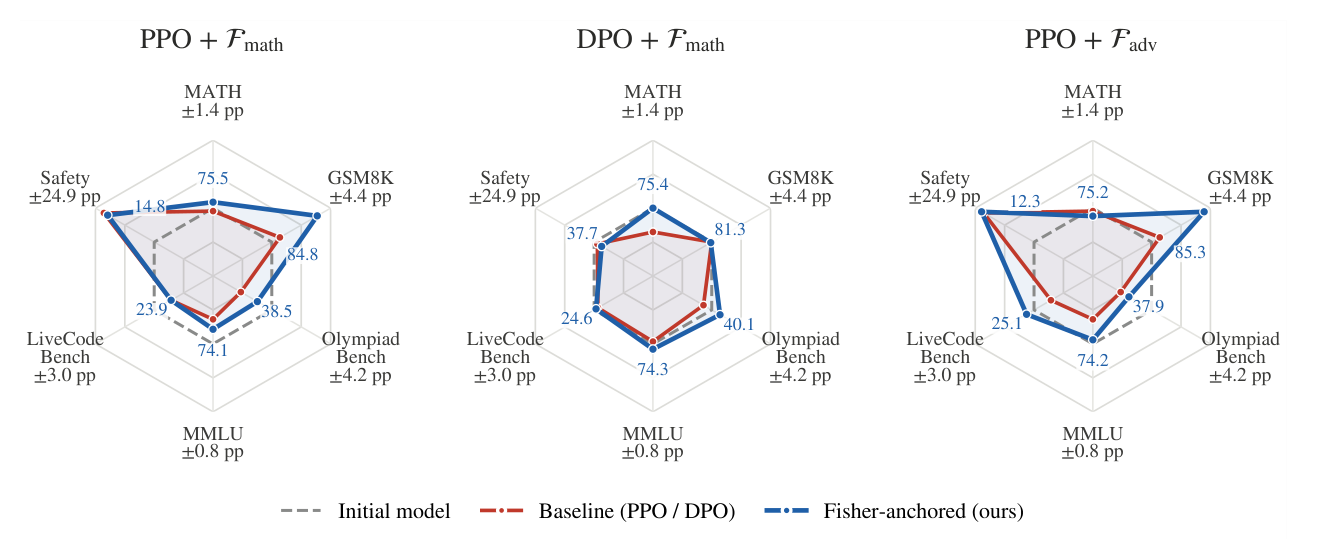
Safety is learned by PPO, and the anchors keep it. Harmful compliance on SORRY-Bench falls from 34.55% for the initial model to 13.18% for PPO. The math, code, and safety anchors finish at 14.77%, 16.59%, and 12.27%. The safety anchor is the lowest final checkpoint in the comparison, and it also reaches 25.12% on LiveCodeBench, just above the initial 24.74%. Relative to the initial policy, those three anchors retain about 93%, 84%, and 104% of PPO’s reduction in harmful compliance. DPO does not buy that safety reduction: its harmful-compliance rate stays near the initial model, including with the math anchor. The capability result and the safety result belong to different optimizers.
What this geometry leaves out
The experiments use a diagonal Fisher, so interactions between coordinates are invisible, and a sensitive direction that lives in those interactions is missed. The 128 calibration prompts overlap the corresponding evaluation sets, so these numbers do not establish the same protection on unseen prompts. The correction can also be the wrong one when the initial policy is weak and the alignment update is trying to repair that same skill: shrinking the sensitive directions then protects the error. The claim the runs support is narrower. On this model, controlling cumulative displacement in the initial policy’s output-sensitive coordinates preserves a selected capability while PPO still learns most of its safety reduction. Related projects study the same directional view of post-training for targeted unlearning and multi-group gradient interference.
Cite the paper
@misc{zhou2027cfp,
  author    = {Zhou, Duo},
  title     = {Where the Policy Moves Matters: Capability Preservation via Cumulative Fisher Protection in {RLHF}},
  year      = {2027},
  note      = {Under review},
  url       = {https://www.duo-zhou.com/projects/cumulative-fisher/}
}