RESEARCH NOTE / November 8, 2026
Euclidean Orthogonality Is Not Retain Invariance
When forget and retain gradients conflict, a Euclidean-orthogonal projection still perturbs retained behavior once AdamW rescales coordinates by its diagonal preconditioner; Geometric-Disentanglement Unlearning projects inside the optimizer's metric so the executed step is first-order retain-invariant across existing unlearning objectives.
Geometric-Disentanglement Language Model Unlearning · EMNLP 2026 Main
Duo Zhou, Yuji Zhang, Tianxin Wei, Ruizhong Qiu, Ke Yang, Xiao Lin, Cheng Qian, Jingrui He, Hanghang Tong, ChengXiang Zhai, Heng Ji, Huan Zhang
arXiv · PDF · Code · Project page
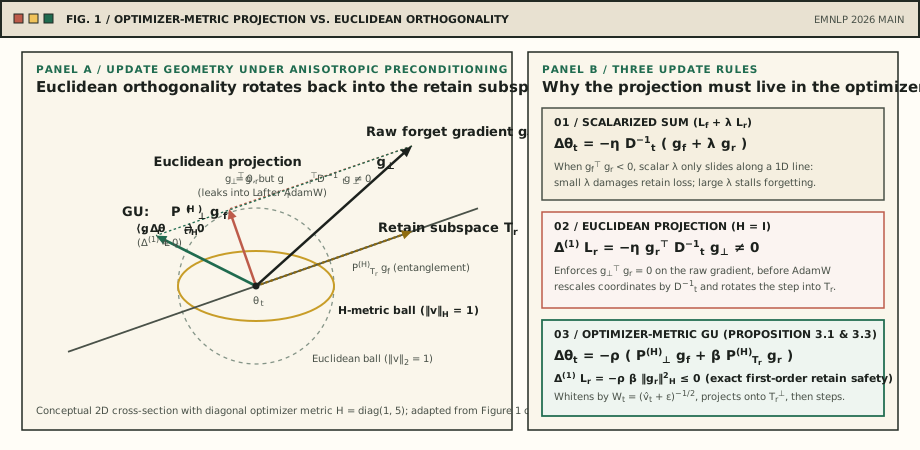
Language model unlearning asks a post-training update to erase the influence of a forget set while leaving a retain set and general capabilities intact. Most algorithms formulate this as a scalarized objective , hoping that a single weight can balance targeted erasure against capability preservation. When the forget and retain gradients share coordinates and point into opposing half-spaces, however, scalar weighting only slides along a one-dimensional conflict. A natural geometric fix from multi-task optimization is to project the forget gradient onto the Euclidean orthogonal complement of the retain gradient before updating. Yet in language model post-training, Euclidean orthogonality does not imply retain invariance: once an adaptive optimizer such as Adam or AdamW rescales coordinates by its diagonal preconditioner , a Euclidean-orthogonal vector is rotated back into the retain-sensitive subspace and still changes the retain loss to first order.
Geometric-Disentanglement Unlearning (GU) resolves this mismatch by defining both the retain-invariance condition and the orthogonal projection inside the metric induced by the optimizer itself. Rather than replacing the unlearning loss, GU leaves the training objective intact and routes the forget and retain gradients through metric-orthogonal projectors before the preconditioned parameter step is applied. Paper, Sections 1 and 3.
1. Why a scalar weight only slides along a one-dimensional conflict
Let be a language model with parameters initialized from a reference model trained on a corpus , where is the forget set to be scrubbed and is the retain set whose behavior must be preserved. Standard gradient-based unlearning samples a paired mini-batch at each step and minimizes a scalarized combination of a forgetting objective and a retention objective :
Here encourages the model to suppress responses tied to (via token-level negative log-likelihood ascent, preference ratios against such as DPO, NPO, or SimNPO, or logit/label calibration such as CEU, UNDIAL, WGA, or SatImp), while anchors behavior on . Paper, Section 2, Equations (1)–(2).
Write the raw Euclidean gradients at step as and . Both gradients act on the same parameter vector . Whenever forgotten and retained examples rely on overlapping internal representations, and share active coordinates and frequently point into opposing half-spaces (). Under that conflict, the combined gradient is confined to the two-ray cone spanned by and :
- Small follows and allows the forgetting update to climb , causing collateral damage to retained knowledge and downstream fluency.
- Large follows and suppresses movement along , stalling erasure of the forget set.
Sweeping only trades one failure mode for the other along a one-dimensional frontier because a scalar loss weight never separates the component of that damages from the component of that can reduce without disturbing . Resolving that interference requires operating on the direction of the parameter update rather than the weight of the loss. Project page; Paper, Sections 1 and 3.1.
2. Why Euclidean orthogonality fails under adaptive optimizers
In multi-task and continual learning, the textbook way to prevent one gradient from harming another is Euclidean orthogonal projection: remove the component of parallel to (or to a subspace of per-sample retain gradients) so that the projected forget vector satisfies
If the optimizer updated parameters by plain stochastic gradient descent , a first-order Taylor expansion of around would give .
In language model post-training, however, the step applied to the parameters is not a scalar multiple of the raw gradient. Adaptive optimizers such as Adam and AdamW maintain a coordinate-wise second-moment accumulator and rescale the update by a positive-definite diagonal preconditioner before moving :
Suppose we feed a Euclidean-orthogonal forget gradient (satisfying ) into the preconditioned step . Expanding the retain loss to first order around reveals why Euclidean orthogonality breaks down:
Because rescales each coordinate by a different factor reflecting historical gradient variance, multiplying by shears the vector out of the Euclidean orthogonal complement of . Enforcing imposes orthogonality on a raw gradient vector that the model never actually takes. Project page; Paper, Section 3.1 and Appendix A.1.
3. Projecting in the optimizer metric: the loss stays, the step changes
3.1 First-order retain invariance as metric orthogonality
To align the invariance guarantee with the executed step, GU formulates “no side effects on retained knowledge” directly in the geometry induced by the optimizer at iteration . Freeze a symmetric positive definite (SPD) metric on with inner product and norm
For Adam-family optimizers with second-moment estimate , the paper defines the diagonal whitening operator and induced metric on each selected parameter tensor as
More generally, for any optimizer applying a linear preconditioner with step direction , setting equates standard Euclidean inner products in whitened coordinates (, ) with -inner products in parameter space: . Paper, Section 3.1, Appendix A.1, Equation (8), and Appendix B.
Rather than protecting only a single averaged retain gradient, GU requires first-order retain invariance across every finite subset of retain examples. For each , let be its sample gradient, and define the retain-gradient subspace and its -orthogonal complement (dropping the subscript on within a fixed step):
For any finite sample with empirical retain loss , the batch gradient lies in . Proposition 3.1 (proved in Appendix C.1 as Proposition C.1) establishes the foundational equivalence:
(Identifying with the true directional derivative via the -gradient yields the identical subspace condition because and share the same orthogonal complement once paired with .) Paper, Section 3.1, Equation (3), Proposition 3.1, and Appendix C.1.
3.2 Tangential entanglement and steepest feasible forgetting
Let be a basis of retain gradient directions collected from a retain mini-batch so that . The -orthogonal projector onto and the complementary projector onto are
When is -orthonormalized via Gram–Schmidt in whitened coordinates (), the projector simplifies to . Every forget gradient then decomposes uniquely into a retain-tangential part and a retain-normal part:
Only the tangential component interacts with to first order. Its -norm defines a concrete, per-step measure of retain–forget gradient entanglement:
which vanishes if and only if . Paper, Section 3.1, Equations (4)–(6).
The retain-invariant subspace has dimension and contains infinitely many safe directions. Which direction in achieves the fastest forgetting progress under an -norm trust-region budget? Define the feasible ball of retain-invariant unit steps
Because every satisfies for and , the linearized change of both the forget objective and the joint objective collapses to . By Cauchy–Schwarz (Lemma 3.2, proved in Appendix C.2), the unique steepest feasible descent direction (whenever ) for both and is the normalized -projected forget gradient:
Crucially, projecting out does not cancel unlearning: unless lies entirely inside (, meaning any first-order improvement on necessarily degrades ), the step remains a strict first-order descent direction for the forget loss, . Paper, Section 3.1, Lemma 3.2, Appendix C.2, and Appendix D.3.
3.3 Split projected update and second-order drift bounds
Rather than projecting the summed gradient (which would annihilate the retain gradient ), GU routes the forget and retain branches through complementary projectors:
Section 3.2 and Appendix C.3–C.4 prove three properties of this split step:
- First-order safety and retain monotonicity (Proposition 3.3): Since and , the first-order change in retain loss is
For , the update is strictly first-order neutral to ; for and , it strictly decreases to first order. 2. Exact one-step retain descent under -smoothness (Corollary 3.4): If is -Lipschitz under , then by -orthogonality , yielding
Thus holds strictly for any step size , while at retain drift is purely second-order, . 3. One-step joint objective decomposition (Proposition 3.5 and Corollary C.1): The first-order change of is
which satisfies whenever or . Paper, Section 3.2, Equations (7)–(11), and Appendices C.3–C.4.
4. A plug-in routing layer for GradDiff, NPO, SimNPO, and beyond
Because GU modifies how gradients are combined rather than how the forget loss is defined, it attaches directly to any gradient-based unlearning objective—including GradDiff, CEU, DPO, NPO, SatImp, SimNPO, UNDIAL, and WGA—without altering their loss functions. Paper, Section 2, Section 3.1, and Appendix B.
4.1 Whitening, KL retain anchor, and sign-aware trust region
Algorithm 1 in Appendix B implements the optimizer-metric projection in five lightweight operations right before optimizer.step():
- KL retain anchor: To probe retained behavior with low-variance gradients and a zero-gradient baseline at , GU defines the retain subspace anchor using forward KL divergence to the frozen reference model on a small retain mini-batch :
- Gradient recovery without a second forward pass: After a standard backward pass on populates in
p.grad, GU computes and algebraically recovers the raw forget gradient . - Whitening by Adam’s second moment: Reusing the optimizer’s existing state with zero additional state allocation, both gradients are whitened via and where . On scheduled refresh steps (every steps), is orthogonalized in
fp32via Gram–Schmidt against the current rank- basis (, stored infp16), appending the normalized residual if its relative norm exceeds threshold. - Sign-aware tangential gate and anisotropic trust region: In whitened coordinates, let and be the projections of the forget and retain gradients along basis vector . Tangential components with (, default ) push in the same direction as (which after gradient descent would increase ) and are discarded. Opposite-signed components with actively decrease to first order; GU retains them under an anisotropic norm cap relative to the safe normal component:
with default . Because every kept term satisfies , this sign-aware rule strengthens Proposition 3.3 to while bounding total step energy by without a line search. 5. De-whitening into the base optimizer: Finally, GU maps the whitened update back via to overwrite the parameter gradient:
When AdamW subsequently applies its preconditioner , the and factors cancel on the projected components, so the actual parameter step lands in the intended -orthogonal direction. Paper, Appendix B, Algorithm 1, Equation (12), and Appendix C.4.
4.2 Why low-rank streaming on top blocks avoids quadratic scaling
Prior projection-based unlearning methods built for image classifiers or small models (such as UNSC, PGU, SEMU, FG-OrIU, and OrthoGrad; reviewed in Appendix A.3) either form activation covariance / Gram matrices across layers or run repeated layerwise SVDs and per-sample QR factorizations. At LLM hidden dimensions (), maintaining and factorizing matrices across layers is prohibitive in both memory and wall-clock time.
GU avoids matrices entirely. It restricts projection to an automatically detected subset of forget-sensitive tensors—the last Transformer blocks, final normalization layer(s), and output head—and maintains the retain basis via streaming vector operations in time per step. Profiling SimNPO + GU on Llama-3.2-1B on an NVIDIA H100-96GB GPU (Appendix E.4, Table 8) confirms that the overhead is negligible across ranks :
| Configuration (Llama-3.2-1B, H100) | Basis Rank | Refresh Period | Wall Time (s) | Time Overhead | Peak Memory (MB) | Forget ES (lower better) | Model Utility (higher better) |
|---|---|---|---|---|---|---|---|
SimNPO (baseline) | — | — | 226 | +0.0% | 20,291 | 0.28 | 0.59 |
SimNPO + GU | 2 steps | 229 | +1.3% | 20,329 (+0.2%) | 0.12 | 0.59 | |
SimNPO + GU | 2 steps | 231 | +2.2% | 21,013 (+3.6%) | 0.12 | 0.60 | |
SimNPO + GU | 2 steps | 233 | +3.0% | 21,231 (+4.6%) | 0.12 | 0.60 |
End-to-end runtime increases by only 1.3–3.0% and peak GPU memory by under 5%, while forget-set Extraction Strength drops by more than half () even at , with capturing the full utility gain. Paper, Appendix A.3 and Appendix E.4, Table 8.
5. What the 72-configuration sweep and ablations show
5.1 Aggregate behavior across 72 TOFU configurations
The main evaluation on TOFU (200 fictitious author profiles with 20 QA pairs each, from the Open Unlearning suite) spans 72 configurations: 3 model backbones (Llama-3.2-1B-Instruct, Llama-3.2-3B-Instruct, Llama-3.1-8B-Instruct) 3 deletion splits (Forget-1%, Forget-5%, Forget-10%) 8 base unlearning objectives (GradDiff, CEU, DPO, NPO, SatImp, SimNPO, UNDIAL, WGA). Every configuration is scored on four axes:
- Retain Extraction Strength (
ES Re., ): how faithfully the model preserves facts from the retain split . - Forget Extraction Strength (
ES Un., ): residual regurgitation on the forget split under constrained prompts (lower means stronger forgetting). - Privacy (
Priv., ): Membership Inference Attack (MIA) closeness to a model trained from scratch on alone ( for the un-finetuned vanilla model; for the fully fine-tuned model). - Model Utility (
MU, ): composite score combining generation probability, ROUGE, and Truth Ratio across retain and real-world factual sets.
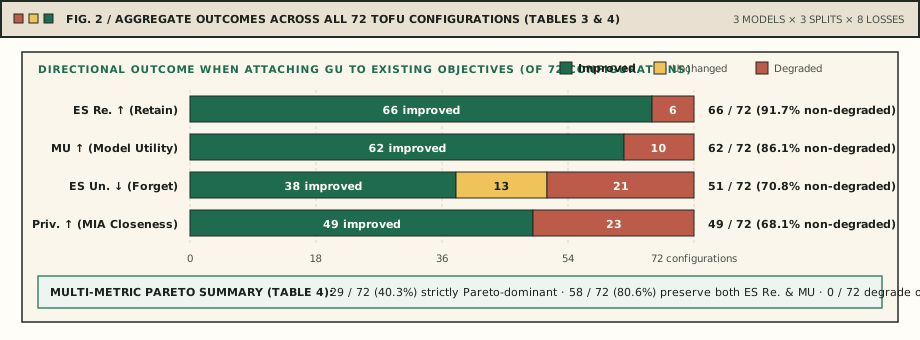
Across the 72 configurations (Tables 1, 3, and 4 of the paper):
- Retain quality (
ES Re.) is improved or preserved in 66 / 72 configurations (91.7%)—strictly improved in 66, unchanged in 0, and slightly lower in 6. - General model utility (
MU) is improved or preserved in 62 / 72 configurations (86.1%)—strictly improved in 62 and lower in 10. - Forgetting efficacy (
ES Un.) is improved or preserved in 51 / 72 configurations (70.8%)—strictly reduced in 38, unchanged at the floor in 13, and higher in 21. - Privacy (
Priv.) is improved or preserved in 49 / 72 configurations (68.1%). - Joint multi-metric dominance: GU is strictly Pareto-dominant (no metric worse and at least one strictly better across all four axes) in 29 / 72 configurations (40.3%), improves or preserves both
ES Re.andMUsimultaneously in 58 / 72 configurations (80.6%), and degrades all four metrics simultaneously in 0 / 72 configurations (0.0%). Paper, Section 4.2, Table 1, and Appendix D, Tables 3–4.
5.2 Headline gains on SimNPO, collapse recovery on CEU, and cross-benchmark results
Attaching GU to SimNPO (the strongest preference-based baseline in Open Unlearning) produces large simultaneous gains in forgetting, retention, privacy, and utility across TOFU, MUSE (Llama-2-7b-hf on Books and News verbatim memorization and QA), and WMDP-cyber (zephyr-7b-beta hazardous capability removal vs. MMLU):
| Benchmark & Split | Backbone | Base Objective | Metric | Baseline | With GU | Relative / Absolute Shift |
|---|---|---|---|---|---|---|
TOFU (Forget-1%) | Llama-3.1-8B | SimNPO | ES Un. (forget, lower better) | 0.3101 | 0.1177 | −62.0% forgetting ES (with ES Re. , Priv. ) |
TOFU (Forget-5%) | Llama-3.2-3B | SimNPO | ES Re. (retain, higher better) | 0.6068 | 0.7977 | +31.5% retain ES, −55.9% ES Un. (), +59.8% Priv. () |
TOFU (Forget-10%) | Llama-3.1-8B | SimNPO | MU (utility, higher better) | 0.6029 | 0.6519 | +8.1% model utility, −46.0% ES Un. (), +46.7% Priv. () |
TOFU (Forget-10%) | Llama-3.2-3B | UNDIAL | ES Re. (retain, higher better) | 0.3538 | 0.7869 | +122.4% retain ES (), MU , ES Un. |
TOFU (Forget-10%) | Llama-3.1-8B | CEU | MU (utility, higher better) | 0.0000 | 0.6773 | Recovers from complete utility collapse () while holding ES Un. at |
MUSE-News | Llama-2-7b-hf | SimNPO | ES Un. (forget, lower better) | 0.1778 | 0.0957 | −46.2% forgetting ES (ROUGE Re. ) |
MUSE-Books | Llama-2-7b-hf | SimNPO | ROUGE Re. & Priv. Leak. | 0.5103 / −54.25 | 0.5980 / −46.49 | +17.2% retained ROUGE, −14.3% privacy-leakage magnitude, −42.2% ES Un. () |
WMDP-cyber | zephyr-7b-beta | SimNPO / WGA | Un. acc. / MMLU | 0.4192 / 0.2550 | 0.4177 / 0.5498 | SimNPO lowers hazardous accuracy by 0.36% () with MMLU ; WGA restores MMLU from |
Paper, Abstract, Section 1, Section 4.2, Tables 1–2, and Appendix D.4–D.5.
Two structural patterns stand out in Table 1 and Table 2:
- Benefits grow with model scale and deletion ratio. As the forget set expands from
Forget-1%toForget-10%or the backbone scales from1Bto8B, forget and retain gradients become more entangled. Unconstrained objectives such asCEUcollapse completely to atForget-5%andForget-10%across all three Llama-3 scales; projecting out the retain-tangential step restoresMUto while keepingES Un.at the floor. - WMDP-cyber is primarily a capability-preservation result. On
WMDP-cyber, GU lowers hazardous accuracy in 4 of 7 objectives (GD,SatImp,SimNPO,UNDIAL) while maintaining or increasing generalMMLUacross all 7 families. Because the projection pulls updates toward the retain manifold, its primary effect onWMDPis preventing general-capability collapse (such as liftingWGAMMLU from to ) rather than acting as a standalone capability-erasure loss. Paper, Appendix D.5.
5.3 Direct ablation of Euclidean versus Adam-diagonal geometry
Does the optimizer metric actually improve over Euclidean projection () when everything else in GU is held fixed? Appendix E.1 (Table 5) runs this exact control on Llama-3.2-1B and Llama-3.2-3B with SimNPO + GU:
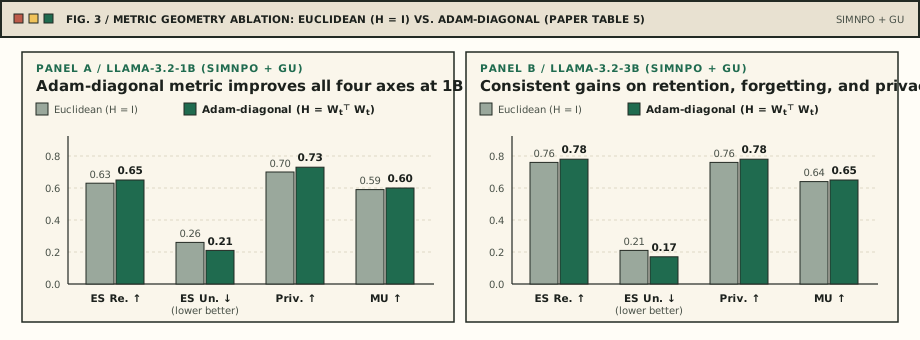
At both model scales, Euclidean projection () already improves substantially over unprojected SimNPO (on 3B, ES Un. drops from to and Priv. rises from to ), confirming that removing retain-gradient conflict is the primary mechanism. Switching from to the Adam-diagonal metric then improves all four metrics at both 1B and 3B:
- On
Llama-3.2-1B,ES Re.rises from ,ES Un.drops from (),Priv.rises from , andMUrises from . - On
Llama-3.2-3B,ES Re.rises from ,ES Un.drops from (),Priv.rises from , andMUrises from .
Appendix E.2–E.3 (Tables 6 and 7) further verify that GU’s gains are neither an artifact of AdamW nor random-seed noise: under SGD on Llama-3.2-3B (Forget-5%), adding GU to SimNPO lifts ES Re. from , cuts ES Un. from , lifts Priv. from , and raises MU from ; across random seeds on Llama-3.2-3B, SimNPO + GU exhibits standard deviations of on every metric against effect sizes of on ES Un. and on Priv.. Paper, Appendix E.1–E.3, Tables 5–7.
6. Open questions: local first-order orthogonality versus long-horizon curvature
GU’s theoretical guarantee is local and first-order. That scope makes the projection cheap enough to run online at LLM scale, and it also defines the boundary of what stepwise gradient projection can guarantee:
- Second-order curvature drift and rotating retain subspaces over long horizons: Corollary 3.4 shows that even when the first-order term is zero at each step, a step of size incurs second-order retain drift bounded by . Over long post-training trajectories, these curvature errors can accumulate as the local retain subspace rotates along the optimization path. While GU’s anisotropic trust region () and tangential repair () damp local drift, controlling cumulative displacement globally from initialization requires bounding the path rather than the single step—the question tackled from a global trajectory perspective in Cumulative Fisher Protection.
- Dependence on a representative retain anchor and mini-batch subspace estimation: Because is estimated from a finite retain mini-batch at rank on selected top layers, any principal angle between the population retain subspace and its low-rank mini-batch estimate leaves a residual first-order leakage of order (Appendix C.3 Remark), and settings without access to representative retain data cannot form directly.
- Diagonal metric approximation: Binding to Adam’s diagonal second-moment state captures coordinate-wise rescaling for free, but ignores off-diagonal cross-parameter curvature within and across attention and MLP blocks.
Together with Cumulative Fisher Protection and Gradient Interference in Group-Aware RLHF, GU points to a unified view of language model post-training: tradeoffs between competing behavioral specifications are governed by the geometry of executed parameter updates rather than scalar weights in the training loss. Project page; Paper, Section 6 and Appendix C.3.
7. Takeaways
- Scalar loss weights cannot disentangle shared parameters. When forget and retain gradients point into opposing half-spaces (), sweeping in only slides along a one-dimensional conflict between collateral damage and incomplete forgetting.
- Euclidean orthogonality is not retain invariance under adaptive optimizers. A forget vector satisfying still changes retain loss to first order by once AdamW applies its coordinate-wise preconditioner . First-order retain invariance across all finite retain subsets holds if and only if the update lies in the -orthogonal complement induced by the optimizer’s metric (Proposition 3.1).
- The loss stays; the step changes. Within the retain-invariant trust region, the normalized -projected forget gradient is the unique steepest feasible descent direction for both and (Lemma 3.2), while the tangential norm measures per-step forget–retain entanglement.
- GU plugs into existing unlearning losses at <3% runtime and <5% memory overhead. By whitening gradients with Adam’s existing second-moment state and maintaining a low-rank () Gram–Schmidt basis on top Transformer blocks and the output head, GU attaches to
GradDiff,NPO,SimNPO,UNDIAL,CEU,SatImp,DPO, andWGAwithout modifying their objectives. - Across 72 TOFU configurations, GU improves or preserves retain quality in 66/72 (91.7%) and model utility in 62/72 (86.1%), with up to 62% stronger forgetting on SimNPO. Direct ablation confirms that projecting in the Adam-diagonal metric outperforms Euclidean projection () across all four evaluation axes on both
Llama-3.2-1BandLlama-3.2-3B.
Cite this note
@misc{zhou2026geometricunlearning,
  author = {Zhou, Duo},
  title  = {{Euclidean Orthogonality Is Not Retain Invariance}},
  year   = {2026},
  url    = {https://www.duo-zhou.com/blog/geometric-unlearning/},
  note   = {Research note}
}